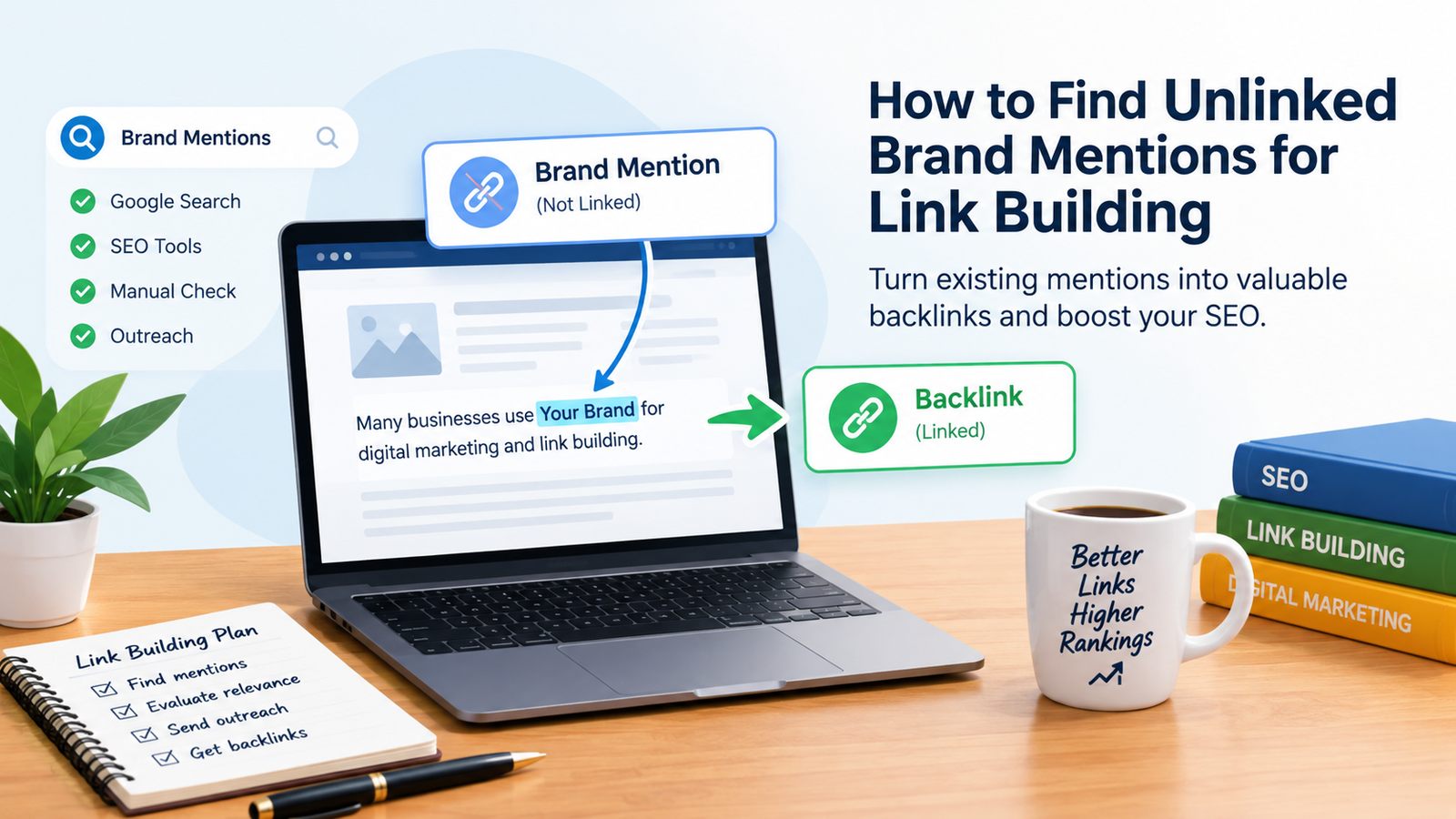
Building backlinks doesn’t always mean starting with a completely cold prospect. In fact, some of the best opportunities may already be sitting across the web.
A website may have mentioned your brand, company, product, service, research, or content without linking back to your site. These references are known as unlinked brand mentions, and they can provide a practical starting point for a link-building campaign.
Instead of asking a publisher to mention your business for the first time, you’re approaching someone who has already decided that your brand is relevant to their content.
So, how do you find these opportunities, and how can you turn them into backlinks?
Let’s break down the process step by step.
What Are Unlinked Brand Mentions?
An unlinked brand mention is a reference to your business or website on another webpage that does not contain a clickable link to your site.
For example, an article might say:
Link Authority provides useful resources for SEO and link building.
If the words Link Authority aren’t connected to your website, that is an unlinked brand mention.
The mention itself isn’t necessarily a backlink. However, if linking to your website would provide additional value to readers, it may become a legitimate outreach opportunity.
What Can Be Considered a Brand Mention?
Don’t limit your search to your company name. Your opportunities may include mentions of:
- Your brand name
- Product names
- Service names
- Company founders
- Original research
- Surveys and statistics
- Case studies
- Guides and resources
- Campaigns
- Proprietary tools
- Infographics
The broader your monitoring, the more opportunities you’re likely to discover.
Why Unlinked Brand Mentions Matter for Link Building
The biggest advantage of unlinked mentions is that they provide a warmer prospect than completely cold outreach.
The website has already referenced your business, which means some level of awareness or relevance exists.
A useful unlinked mention may provide opportunities for:
Relevant Backlinks
If your resource directly supports the article, a publisher may consider adding a link for readers who want more information.
Referral Traffic
A link from a relevant publication can potentially send interested visitors to your website.
Brand Visibility
Even when a publisher doesn’t add a link, the existing mention can still contribute to your online visibility.
Relationship Building
Professional outreach can open the door to future editorial opportunities, collaborations, interviews, or content contributions.
The important point is to focus on usefulness rather than simply acquiring another backlink.
How to Find Unlinked Brand Mentions
There are several ways to discover unlinked mentions. You can start manually with Google and then use SEO and brand-monitoring tools for larger campaigns.
1. Search Google for Your Brand Name
The simplest approach is to search for your exact brand name.
Use a query such as:
“Your Brand Name”
Then exclude your own website:
“Your Brand Name” -yourwebsite.com
This can help uncover third-party pages where your business has been mentioned.
You can repeat the process with different variations of your brand name.
Search for Product and Service Names
Your products and services may generate mentions even when your company name isn’t included.
Try searches such as:
“Product Name” -yourwebsite.com
or:
“Service Name” -yourwebsite.com
This is particularly useful for companies with multiple products, tools, or services.
2. Search for Original Content
Some of the strongest opportunities aren’t traditional brand mentions.
Other websites may reference your:
- Research
- Statistics
- Reports
- Studies
- Surveys
- Articles
- Guides
- Data
- Images
For example, if you publish an original industry report and another website quotes one of your statistics without linking to the report, you may have a highly relevant outreach opportunity.
Search for distinctive phrases, report titles, statistics, and resource names associated with your content.
3. Monitor Your Brand Regularly
Brand monitoring can make the process much easier.
Instead of manually checking Google every day, monitoring platforms can notify you when your brand or selected keywords appear online.
This is especially helpful for established businesses that receive mentions from many websites.
Useful tool categories include:
- Brand monitoring platforms
- SEO tools
- Backlink analysis software
- Web monitoring services
- Content discovery tools
The objective is to find new, relevant mentions before they become difficult to track.
How to Identify the Best Unlinked Mentions
Finding hundreds of mentions doesn’t necessarily mean you have hundreds of good link opportunities.
Quality control is essential.
Check Topical Relevance
First, ask whether the page is genuinely related to your business or subject.
A mention of an SEO company on a digital marketing publication is naturally more relevant than the same mention on an unrelated website.
The closer the relationship between your brand and the page topic, the stronger the outreach rationale.
Evaluate the Page
Look beyond domain-level SEO metrics.
Review the actual page where your brand is mentioned.
Consider:
- Is the content useful?
- Is it original?
- Does it appear professionally maintained?
- Is the subject relevant?
- Does the website have a genuine audience?
- Would your link help readers?
A high-quality page with genuine editorial value should generally be a higher priority than a page selected simply because it has a high third-party metric.
Confirm the Mention Is Actually Unlinked
Before sending an outreach email, verify that the mention doesn’t already contain a link.
Check the brand name and surrounding text carefully.
Also remember that a website may already link to your homepage elsewhere on the page while leaving another relevant mention unlinked.
How to Turn Unlinked Brand Mentions Into Backlinks
Once you’ve identified a worthwhile opportunity, you can contact the website owner or editor.
The best outreach is short, personalized, and relevant.
Use a Professional Outreach Email
Here’s a ready-to-use example:
Subject: Link suggestion for your article
Hi,
I was reading your article about unlinked brand mentions and link building and noticed that you mentioned our brand.
Thank you for including us in the article.
If you feel it would be useful for your readers, you could link the mention to our relevant resource so visitors can easily find additional information.
Thanks again for mentioning our work, and I appreciate your time.
Best regards,
Link Building Team
The message is intentionally simple. You’re making a suggestion rather than demanding a backlink.
Link to the Most Relevant Page
One common mistake is always requesting a link to the homepage.
Instead, identify the page that best matches the context.
For example:
- A research mention → link to the original research
- A product mention → link to the product page
- A statistics mention → link to the relevant data page
- A topic mention → link to a detailed guide
The more useful the destination page is, the stronger your request becomes.
Best Practices for Unlinked Brand Mention Outreach
Personalize Every Important Prospect
Mention the article title or specific section where your brand appears.
This shows that you’ve actually reviewed the page.
Explain the Value
Don’t just ask for a link. Explain how the suggested resource could help readers.
Keep Outreach Concise
Editors and website owners are busy. A short, professional email is usually easier to understand than a long sales message.
Follow Up Politely
If you don’t receive a response, a brief follow-up can be reasonable. Avoid sending repeated messages that become intrusive.
Prioritize Quality
You don’t need to contact every website that mentions your brand.
Focus on the most relevant and credible opportunities first.
Common Unlinked Mention Link-Building Mistakes
Even a good strategy can become ineffective when executed poorly.
Avoid these common mistakes:
- Sending the same email to every website
- Targeting completely unrelated websites
- Requesting links without explaining their value
- Focusing only on domain authority metrics
- Using overly promotional language
- Demanding exact-match anchor text
- Asking for links to irrelevant pages
- Treating every mention as a guaranteed backlink
- Repeatedly contacting publishers after a clear rejection
Remember, a brand mention does not automatically mean a website owner has to add a link. Editorial decisions belong to the publisher.
Unlinked Brand Mentions vs Traditional Link Building
Traditional outreach often starts with a website that has never mentioned your brand.
Unlinked mention outreach starts from a different position: the brand is already part of the publisher’s content.
That can make the conversation more natural.
However, it doesn’t mean every unlinked mention will become a backlink. The content still needs to be relevant, the suggested link should genuinely help readers, and the publisher must be willing to update the page.
That’s why this strategy works best as one part of a broader link-building campaign.
Final Thoughts
Unlinked brand mentions can be valuable link-building opportunities hiding in plain sight.
The process is straightforward: monitor your brand and content, discover mentions on third-party websites, identify which mentions don’t contain links, evaluate the quality of each opportunity, and contact publishers with a relevant resource.
