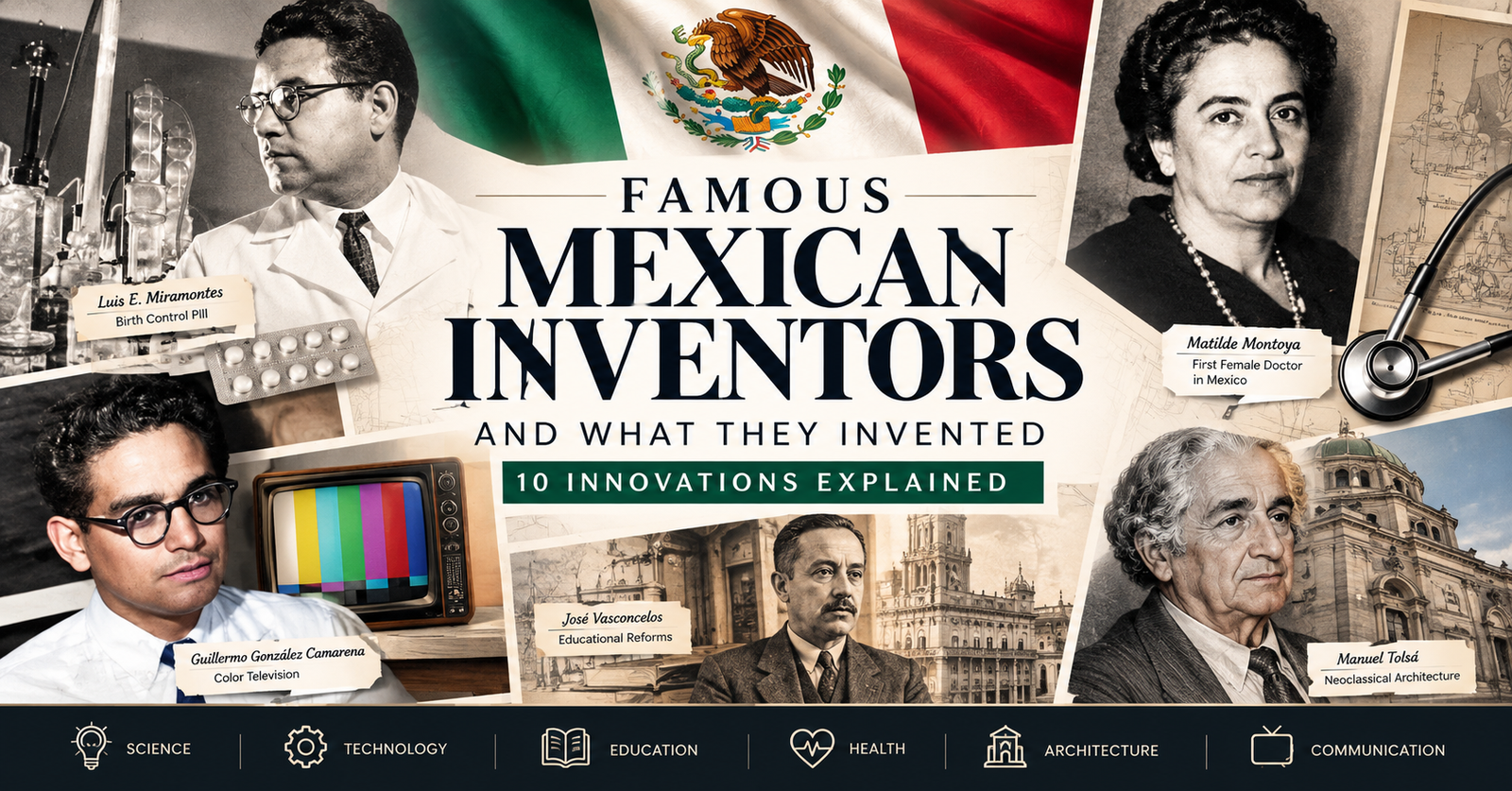
When you think about famous Mexican inventors, you might immediately think of television technology or scientific breakthroughs. Mexico has produced innovators whose work has influenced everything from color television and medical technology to robotics, transportation, communications, and environmental science.
Some inventions were created to solve very specific technical problems. Others emerged from years of scientific research and eventually changed how millions of people live.
In this guide, we’ll look at 15 famous Mexican inventors, scientists, and innovators, explain what they created or helped develop, and show why each contribution matters.
What Has Mexico Invented?
Mexico has a long history of technological and scientific innovation.
Among the inventions and innovations associated with Mexican inventors are:
- Color television technology
- The contraceptive pill’s key synthetic hormone
- Earthquake-resistant building technology
- The world’s first automatic tortilla machine
- Rocket and space technology
- Solar energy research
- Anti-pollution technology
- Medical and biotechnology innovations
- Robotics and artificial intelligence research
Not every person on this list invented a consumer product in the traditional sense. Some developed scientific discoveries or technologies that became building blocks for later inventions.
That distinction matters when discussing Mexican innovation.
1. Guillermo González Camarena Color Television Technology
Guillermo González Camarena is probably the first name to mention when discussing famous Mexican inventors.
Born in Guadalajara in 1917, González Camarena became an engineer and inventor interested in television technology.
His best-known achievement was the development of a color television system.
What Did González Camarena Invent?
In the 1940s, he developed a color television system known as the Chromoscopic Adapter for Television Equipment.
He patented his color television technology in Mexico in 1940.
The system used a rotating color disc to create color images from television signals.
His work helped demonstrate that television could move beyond black-and-white broadcasting.
Why Was It Important?
Color television eventually became a standard part of home entertainment around the world.
Although other researchers were simultaneously developing competing systems, González Camarena’s work remains an important achievement in Mexican engineering history.
2. Luis Ernesto Miramontes A Key Compound Used in the Oral Contraceptive Pill
Luis Ernesto Miramontes was a Mexican chemist whose work had an enormous impact on reproductive medicine.
In 1951, while working with scientists at Syntex in Mexico City, Miramontes helped synthesize norethisterone, a synthetic progestin.
What Did Miramontes Invent?
Miramontes did not single-handedly invent the modern contraceptive pill.
Instead, his synthesis of norethisterone became a critical step in the development of an effective oral contraceptive.
The compound could be administered orally and became one of the hormonal components used in contraceptive medicine.
Why Was It Important?
The development of reliable oral contraception transformed reproductive healthcare and family planning.
Miramontes’ contribution is therefore one of the most consequential examples of Mexican scientific innovation.
3. Mario Molina Research That Helped Protect the Ozone Layer
Mario Molina was a Mexican chemist rather than a traditional inventor, but his scientific contribution deserves a place on any list of major Mexican innovators.
He studied the effects of chlorofluorocarbons (CFCs) on the Earth’s ozone layer.
What Did Mario Molina Discover?
Molina and his colleagues demonstrated that CFCs could reach the stratosphere and participate in chemical reactions that destroy ozone.
Their research helped scientists and policymakers understand the seriousness of ozone depletion.
Why Was It Important?
Molina shared the 1995 Nobel Prize in Chemistry for this work.
His research contributed to international efforts to restrict ozone-depleting substances and remains one of the most important examples of science influencing global environmental policy.
4. Manuel Sandoval Vallarta Contributions to Physics
Manuel Sandoval Vallarta was one of Mexico’s most important theoretical physicists.
He studied cosmic rays and their behavior in Earth’s magnetic field.
What Did Sandoval Vallarta Contribute?
His research helped scientists better understand how cosmic rays interact with Earth’s magnetic environment.
While this wasn’t a consumer invention, it was a significant scientific contribution from a Mexican physicist.
Why Does It Matter?
Scientific breakthroughs don’t always result in a physical product.
Research into cosmic rays, electromagnetism, and particle behavior contributed to the broader development of modern physics.
5. Victor Celorio The Instant Book and eBook Technology
Mexican engineer and inventor Víctor Celorio developed technology intended to make digital book publishing and distribution more efficient.
What Did Celorio Invent?
Celorio developed the Instabook system, a technology designed to print and bind books rapidly on demand.
His system aimed to address a simple problem:
Why should books need to be printed, stored, shipped, and transported long distances when they could be produced where the reader needs them?
The concept anticipated some of the ideas behind modern print-on-demand publishing.
Why Was It Important?
Print-on-demand technology can reduce the need for large inventories and allow books to be produced closer to the customer.
Celorio’s work demonstrates how Mexican inventors have tackled problems in publishing and information distribution.
6. José Hernández-Rebollar Technology for Translating Hand Movements
José Hernández-Rebollar developed technology that could translate hand and finger movements into computer commands.
What Did He Invent?
His research included the AcceleGlove, a glove equipped with sensors capable of detecting hand and finger movements.
The system could interpret gestures and translate them into digital information.
Why Was It Important?
Gesture-recognition technology has potential applications in:
- Assistive technology
- Human-computer interaction
- Sign-language interpretation
- Rehabilitation
- Robotics
The invention shows how wearable technology can bridge physical movement and digital systems.
7. Arturo Rosenblueth Cybernetics and Medical Research
Arturo Rosenblueth was a Mexican physiologist and scientist whose research helped establish important ideas in physiology and cybernetics.
What Did Rosenblueth Contribute?
Rosenblueth worked on how biological systems regulate themselves and collaborated with mathematician Norbert Wiener and engineer Julian Bigelow.
Their work helped develop the theoretical foundations of cybernetics.
Why Was It Important?
Cybernetics influenced later research into:
- Robotics
- Automation
- Artificial intelligence
- Control systems
- Neuroscience
Rosenblueth’s contribution demonstrates that an invention can sometimes be an idea or scientific framework rather than a physical machine.
8. Héctor Mayagoitia Domínguez Environmental Innovation
Mexican scientists and engineers have also contributed to environmental technology.
Héctor Mayagoitia Domínguez was a scientist and academic associated with research and technological development in Mexico.
His career represents the broader growth of Mexican scientific institutions and efforts to develop technologies addressing environmental and industrial challenges.
Environmental innovation is increasingly important in areas such as energy efficiency, pollution control, and sustainable manufacturing.
9. Heberto Castillo Engineering and Structural Innovation
Heberto Castillo was a Mexican engineer, inventor, politician, and academic.
He developed engineering concepts and structural systems, including innovations associated with construction.
What Did Castillo Invent?
One of his notable engineering contributions was the Tridilosa, a lightweight structural system designed to reduce the amount of material required in certain construction applications.
The system combined steel and concrete in a way intended to create strong but relatively lightweight structures.
Why Was It Important?
Construction engineers constantly face the same challenge:
How do you create structures that are strong without making them unnecessarily heavy or expensive?
Castillo’s work addressed that problem through structural engineering.
10. Guillermo Haro Astronomical Discoveries
Guillermo Haro was a Mexican astronomer who made important contributions to the study of stars and celestial objects.
What Did Haro Discover?
Haro identified and studied various astronomical objects, including Herbig–Haro objects, which are associated with young stars.
He also discovered numerous variable stars and other astronomical phenomena.
Why Was It Important?
Astronomy depends on identifying and understanding objects that reveal how stars and galaxies form.
Haro helped establish Mexico as a country capable of conducting significant astronomical research.
11. Luis E. Miramontes Pharmaceutical Chemistry
Miramontes deserves additional attention because his scientific career illustrates how a laboratory discovery can become a technology with enormous social consequences.
His work at Syntex contributed to advances in steroid chemistry.
The synthesis of norethisterone became especially important because it could be used in oral hormonal contraception.
That made Miramontes’ contribution relevant not only to chemistry but also to medicine and public health.
12. Nabor Carrillo Flores Engineering and Water Management
Nabor Carrillo Flores was a Mexican civil engineer and scientist who contributed to geotechnical engineering and the understanding of Mexico City’s challenging ground conditions.
What Did Carrillo Contribute?
His research focused heavily on the behavior of Mexico City’s soft lakebed soils.
That work became important for engineering projects in a city where construction is complicated by subsidence and unusual geological conditions.
Why Was It Important?
Engineering innovations aren’t always gadgets.
Sometimes the breakthrough is a better understanding of the environment in which buildings, roads, tunnels, and other infrastructure must operate.
13. Rodolfo Neri Vela Space Technology and Communications
Rodolfo Neri Vela became the first Mexican citizen to travel into space in 1985.
He flew aboard NASA’s Space Shuttle Atlantis during mission STS-61-B.
What Did Neri Vela Contribute?
As a payload specialist, Neri Vela worked with experiments and communications-related payloads during the mission.
His career also helped promote engineering and science education in Mexico.
Why Was It Important?
Space exploration requires expertise in:
- Electrical engineering
- Communications
- Materials
- Computer systems
- Physics
- Aerospace technology
Neri Vela became an important symbol of Mexico’s participation in space science.
14. Carlos Slim Helú Telecommunications Innovation and Infrastructure
Carlos Slim is best known as a businessman rather than an inventor, so he should be viewed differently from González Camarena or Miramontes.
His importance to Mexican technological development comes primarily through telecommunications infrastructure and business investment.
Through América Móvil and related companies, Slim became one of the most influential figures in the development and expansion of telecommunications networks across Latin America.
Why Include Him?
Innovation isn’t always about personally creating a patented device.
Building and expanding systems that allow millions of people to communicate can also have a major technological and economic impact.
15. Mexican Engineers Behind the Tortilla Machine
One of Mexico’s most practical technological innovations is the automatic tortilla-making machine.
The machine emerged from Mexican engineering efforts to mechanize the production of tortillas at commercial scale.
Why Was It Important?
Tortillas are a fundamental part of Mexican cuisine, and producing them by hand requires substantial time and labor.
Automated tortilla machinery allowed manufacturers and restaurants to produce large quantities more consistently.
The technology eventually became important beyond Mexico as Mexican food became increasingly popular internationally.
Why Mexican Inventions Matter
Looking at these innovations together reveals something interesting.
Mexican inventors haven’t worked in just one field. Their contributions span:
- Television: Guillermo González Camarena
- Medicine: Luis Miramontes
- Environmental science: Mario Molina
- Engineering: Heberto Castillo and Nabor Carrillo Flores
- Astronomy: Guillermo Haro
- Space science: Rodolfo Neri Vela
- Publishing technology: Víctor Celorio
- Wearable technology: José Hernández-Rebollar
- Cybernetics: Arturo Rosenblueth
- Food manufacturing: Tortilla-making technology
Some of these inventions are physical machines. Others are chemical processes, scientific discoveries, engineering systems, or theoretical ideas.
That’s an important distinction when talking about famous Mexican inventors and what they invented.
How Mexican Inventors Solved Everyday Problems
One thing connects many of these innovations: they began with a practical problem.
González Camarena wanted to improve television.
Miramontes worked on chemical compounds that could be used in medicine.
Celorio tackled the problem of producing books on demand.
Castillo worked on making structural systems more efficient.
Hernández-Rebollar explored ways for computers to understand human movement.
This is a useful way to think about invention.
A great invention doesn’t necessarily begin with the question, “What can I create?”
Often it begins with:
“What problem can I solve?”
Frequently Asked Questions
Who is the most famous Mexican inventor?
Guillermo González Camarena is one of the best-known Mexican inventors because of his work on color television technology.
What did Guillermo González Camarena invent?
He developed and patented a color television system in Mexico in 1940. His system used a color-filter approach to produce color television images.
What did Luis Miramontes invent?
Miramontes was part of the team that synthesized norethisterone, a synthetic progestin that became an important component in the development of oral contraceptives.
What did Mario Molina invent?
Molina is better described as a scientist than an inventor. His research demonstrated the role of CFCs in ozone depletion and contributed to the scientific foundation for international action to protect the ozone layer.
Did Mexico invent color television?
Mexican engineer Guillermo González Camarena developed and patented an early color television system. Other inventors and companies were also developing competing color-TV technologies internationally.
Who was the first Mexican person in space?
Rodolfo Neri Vela became the first Mexican citizen to travel into space when he flew aboard Space Shuttle Atlantis in 1985.
What are some Mexican inventions used in everyday life?
Mexican innovation has contributed to technologies and systems involving color television, pharmaceutical chemistry, construction, food manufacturing, telecommunications, and digital publishing.
Final Takeaway
The story of famous Mexican inventors is much broader than a single television patent.
From Guillermo González Camarena’s color television technology to Luis Miramontes’ work in pharmaceutical chemistry, Mexican innovators have contributed to fields that affect communication, medicine, engineering, environmental protection, food production, and space exploration.
What makes these stories particularly interesting is the variety of problems they attempted to solve.
